Home › Security Architecture & Engineering
Security Models Explained — Overview (Part 1)
Security Architecture & EngineeringCISSP
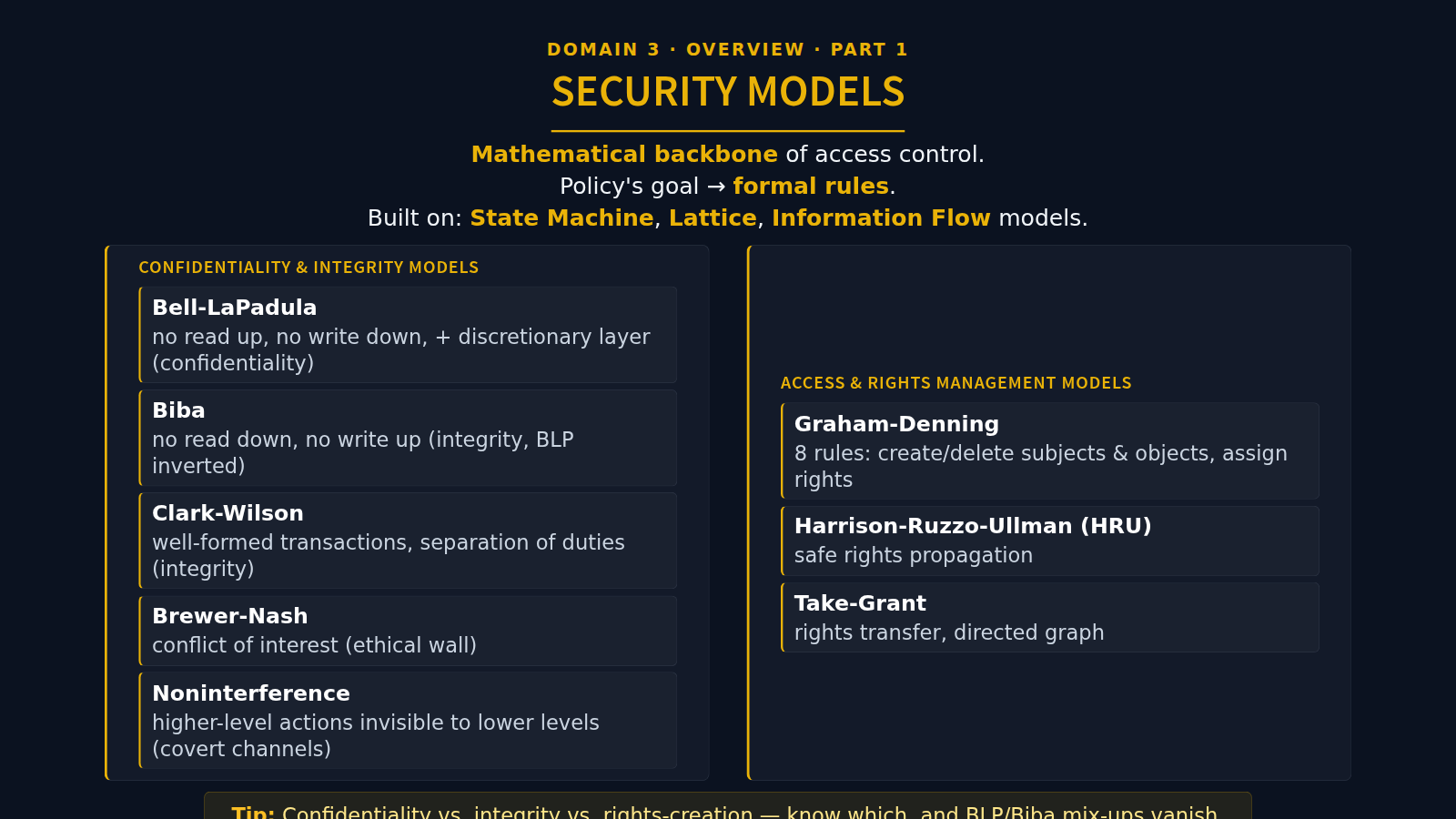
Security models are the mathematical backbone behind access control — where a security policy states a goal in plain language, a security model turns it into rules a system can actually enforce. This is Part 1 of our Security Models series (CISSP Domain 3: Security Architecture and Engineering): a direct overview of every model before we dive into each one in depth.
What you will learn
- The state machine, lattice, and information flow models — the shared foundation every other model builds on
- Bell-LaPadula — confidentiality: no read up, no write down
- Biba — integrity: no read down, no write up (Bell-LaPadula turned inside out)
- Clark-Wilson — commercial integrity via well-formed transactions and separation of duties
- Brewer-Nash (Chinese Wall) — dynamic access control to prevent conflicts of interest
- Noninterference — closing the covert-channel gap Bell-LaPadula leaves open
- Graham-Denning — how subjects and objects are securely created, deleted, and assigned rights
- Harrison-Ruzzo-Ullman (HRU) — how access rights safely propagate through a system
- Take-Grant — modeling rights transfer as a directed graph