Home › Security Architecture & Engineering
Noninterference Model Explained — Security Models (Part 9)
Security Architecture & EngineeringCISSP
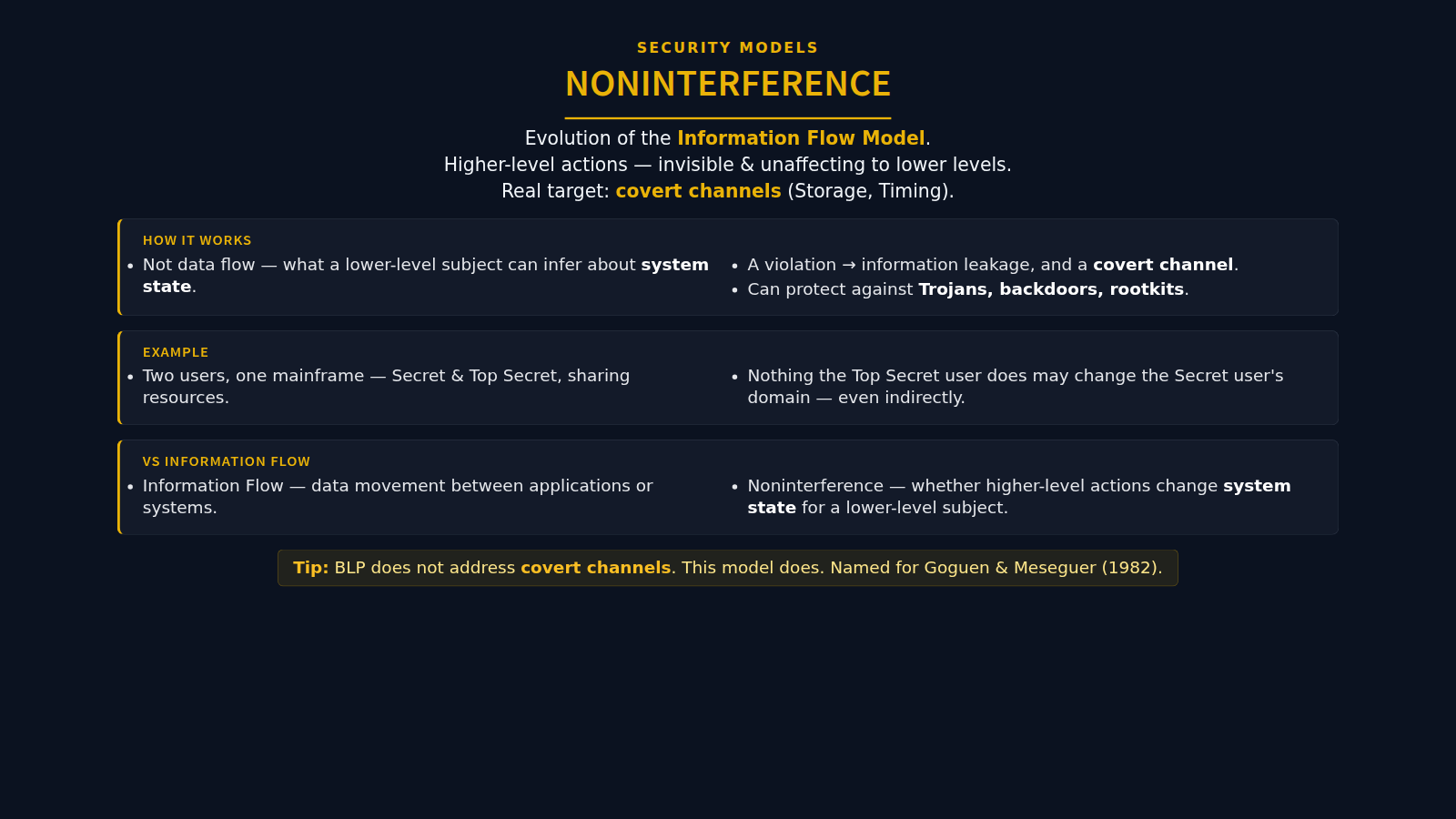
Noninterference is an evolution of the information flow model: higher-level actions must not affect or even be noticed by a lower-level subject — and its real intent is to address covert channels. In Part 9 of our Security Models series, we cover how it works, the shared-mainframe example, how it differs from information flow, and why it matters next to Bell-LaPadula.
What you will learn
- What the Noninterference model is, as an evolution of the Information Flow model
- Why higher-level actions must be invisible and unaffecting to lower levels
- How a violation becomes information leakage and a covert channel — storage or timing
- How the model can also protect against Trojans, backdoors, and rootkits
- A shared-mainframe example: Secret and Top Secret users on the same system
- How Noninterference differs from Information Flow — system state, not data movement
- Why Bell-LaPadula does not address covert channels, and this model does
- The origin: Goguen and Meseguer, 1982