Home › Security Architecture & Engineering
Clark-Wilson Model Explained — Security Models (Part 4)
Security Architecture & EngineeringCISSP
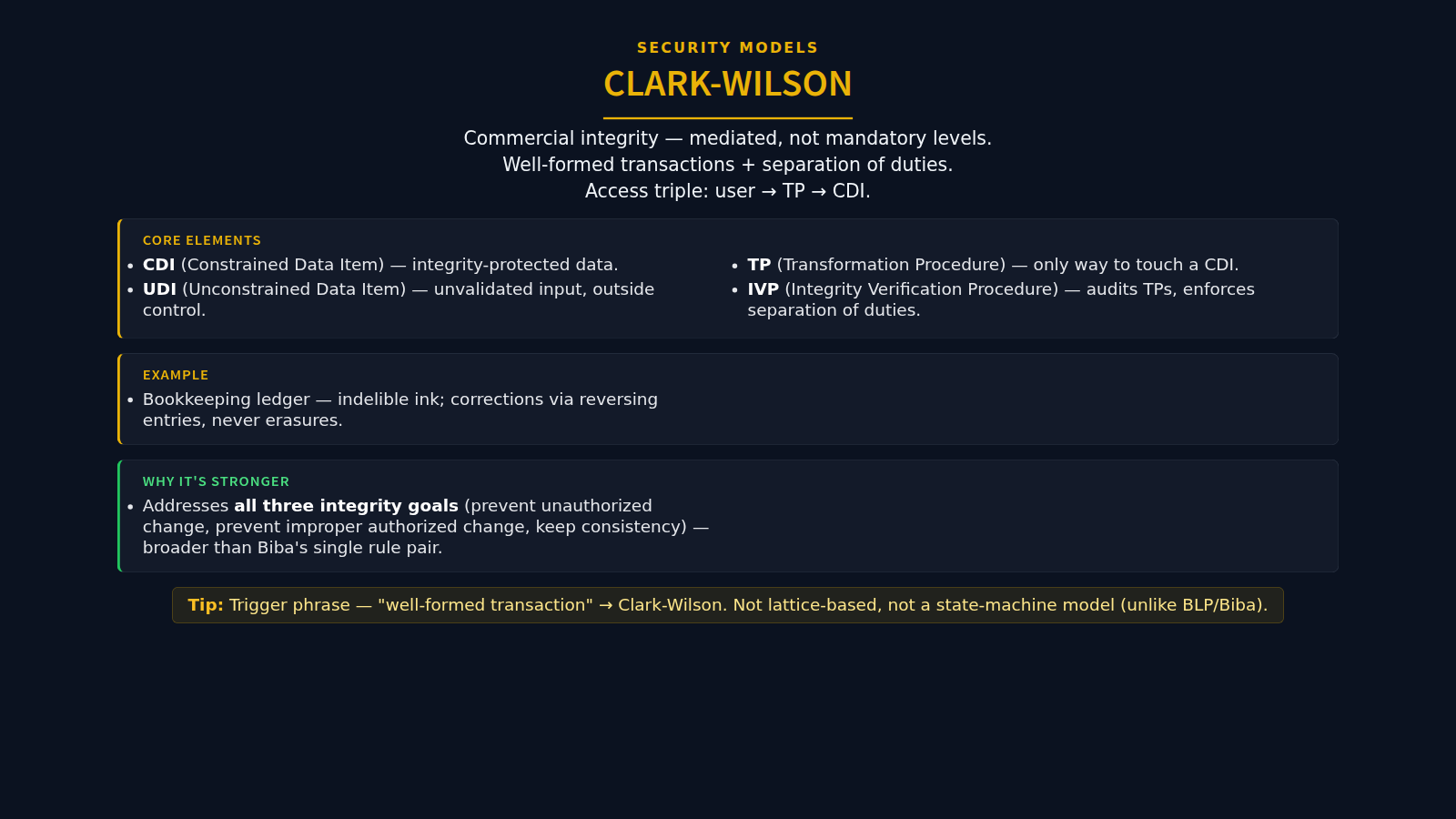
Clark-Wilson is a commercial integrity model — instead of mandatory security levels, it mediates every change through a controlled procedure. In Part 4 of our Security Models series, we cover the access triple, the four named pieces, the ledger example, and why it is treated as broader than Biba on integrity.
What you will learn
- Commercial integrity — mediated changes, not mandatory levels
- Well-formed transactions and separation of duties
- The access triple: user → TP → CDI
- CDI, UDI, TP, and IVP — the four named pieces
- The ledger example of a well-formed transaction
- Why Clark-Wilson is described as covering all three goals of integrity
- The exam trigger: "well-formed transaction," and why this is not a lattice or state-machine model