Home › Security Architecture & Engineering
Cryptography Explained — Overview (Part 1)
Security Architecture & EngineeringCISSPSecurity+
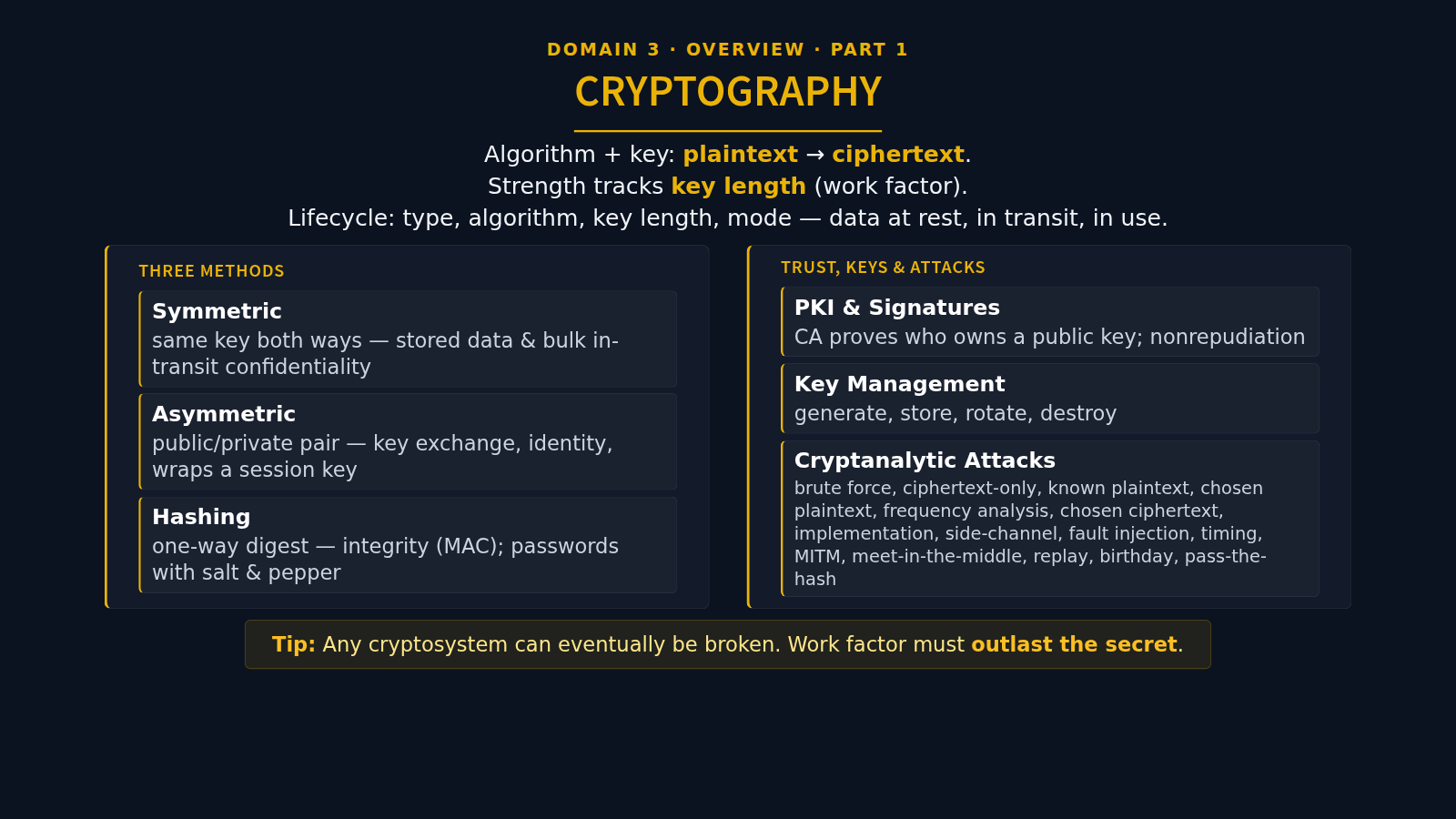
Cryptography turns plaintext into ciphertext with an algorithm and a key — and any cryptosystem can eventually be broken, so the work factor has to outlast the secret. This is Part 1 of our Cryptography series (CISSP Domain 3: Security Architecture and Engineering): a direct overview of the methods before we dive into each one in depth.
What you will learn
- How an algorithm and a key turn plaintext into ciphertext, and why key length drives work factor
- The cryptographic lifecycle: type, algorithm, key length, mode — plus data at rest, in transit, and in use
- Symmetric encryption — same key both ways; stored data and bulk in-transit confidentiality
- Asymmetric encryption — public/private pair; key exchange, identity, wrapping a session key
- Hashing — one-way integrity (MAC) and passwords with salt and pepper
- PKI and digital signatures — a CA proves who owns a public key; nonrepudiation
- Key management — generate, store, rotate, destroy
- Cryptanalytic attacks — brute force, ciphertext-only, known plaintext, chosen plaintext, frequency analysis, chosen ciphertext, implementation, side-channel, fault injection, timing, MITM, meet-in-the-middle, replay, birthday, pass-the-hash