Home › Security Architecture & Engineering
Asymmetric Encryption Explained — Cryptography (Part 3)
Security Architecture & EngineeringCISSPSecurity+
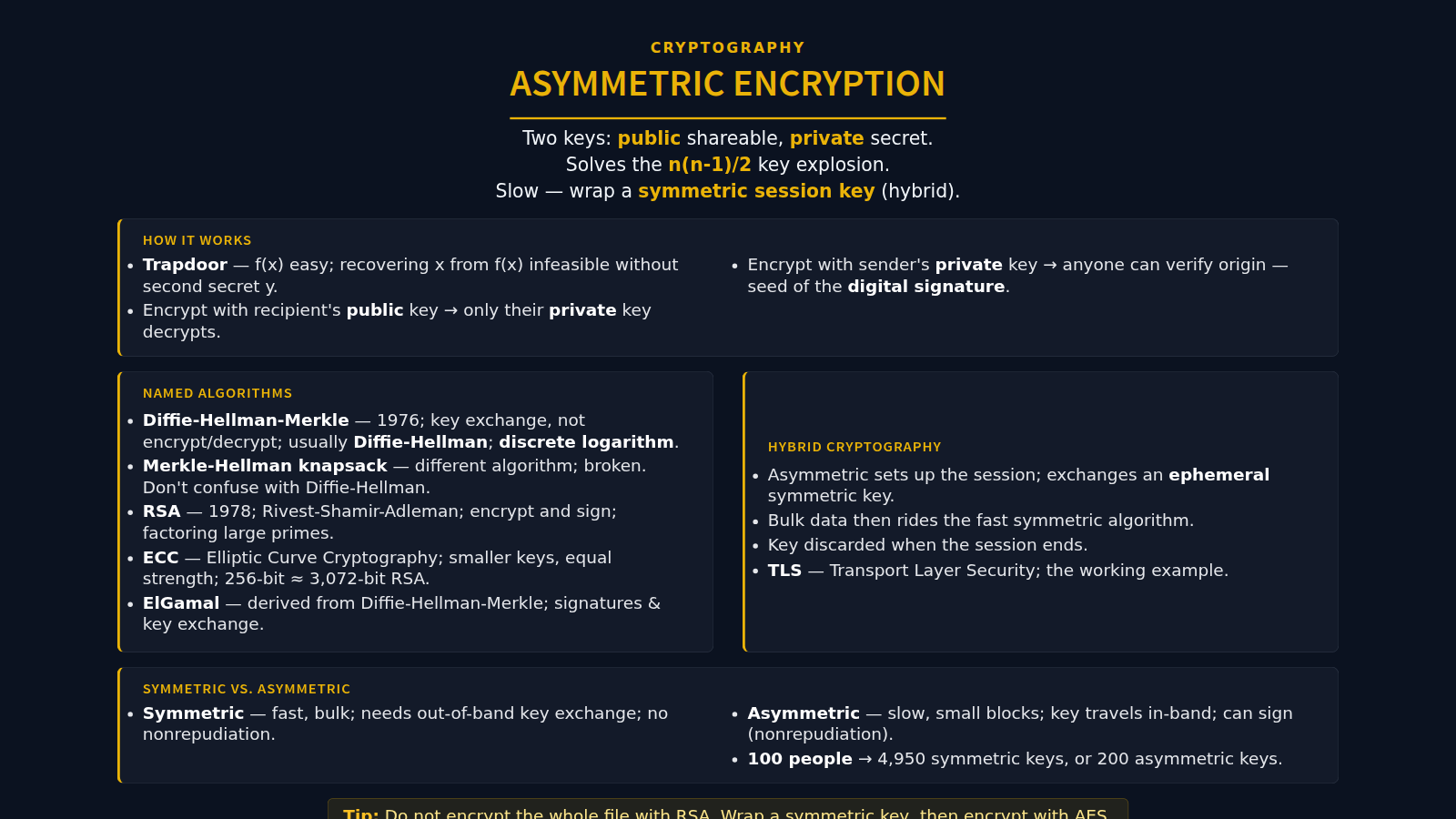
Asymmetric encryption uses a public/private key pair to solve the n(n-1)/2 explosion of shared secrets — and in practice it wraps a symmetric session key rather than encrypting the whole payload. In Part 3 of our Cryptography series, we cover trapdoor functions, Diffie-Hellman-Merkle, RSA, ECC, hybrid cryptography, and why the two types complement each other.
What you will learn
- Public vs private keys — encrypt with one, decrypt only with the other
- How public-key cryptography solves the n(n-1)/2 key-sharing problem
- Trapdoor functions — easy one way, infeasible to reverse without the secret
- Diffie-Hellman-Merkle — 1976; key exchange, not encryption; usually heard as Diffie-Hellman; security is the discrete logarithm problem (Merkle-Hellman knapsack is something else)
- RSA — 1978; encrypt and sign; factoring large primes
- ECC — smaller keys, equivalent strength
- Hybrid cryptography — ephemeral symmetric session key; TLS as the working example
- Why symmetric is fast/bulk and asymmetric is slow/scalable — and why 100 people need 4,950 symmetric keys or 200 asymmetric ones
- Why you wrap a symmetric key instead of encrypting the whole file with RSA