Home › Security Architecture & Engineering
Symmetric Encryption Explained — Cryptography (Part 2)
Security Architecture & EngineeringCISSPSecurity+
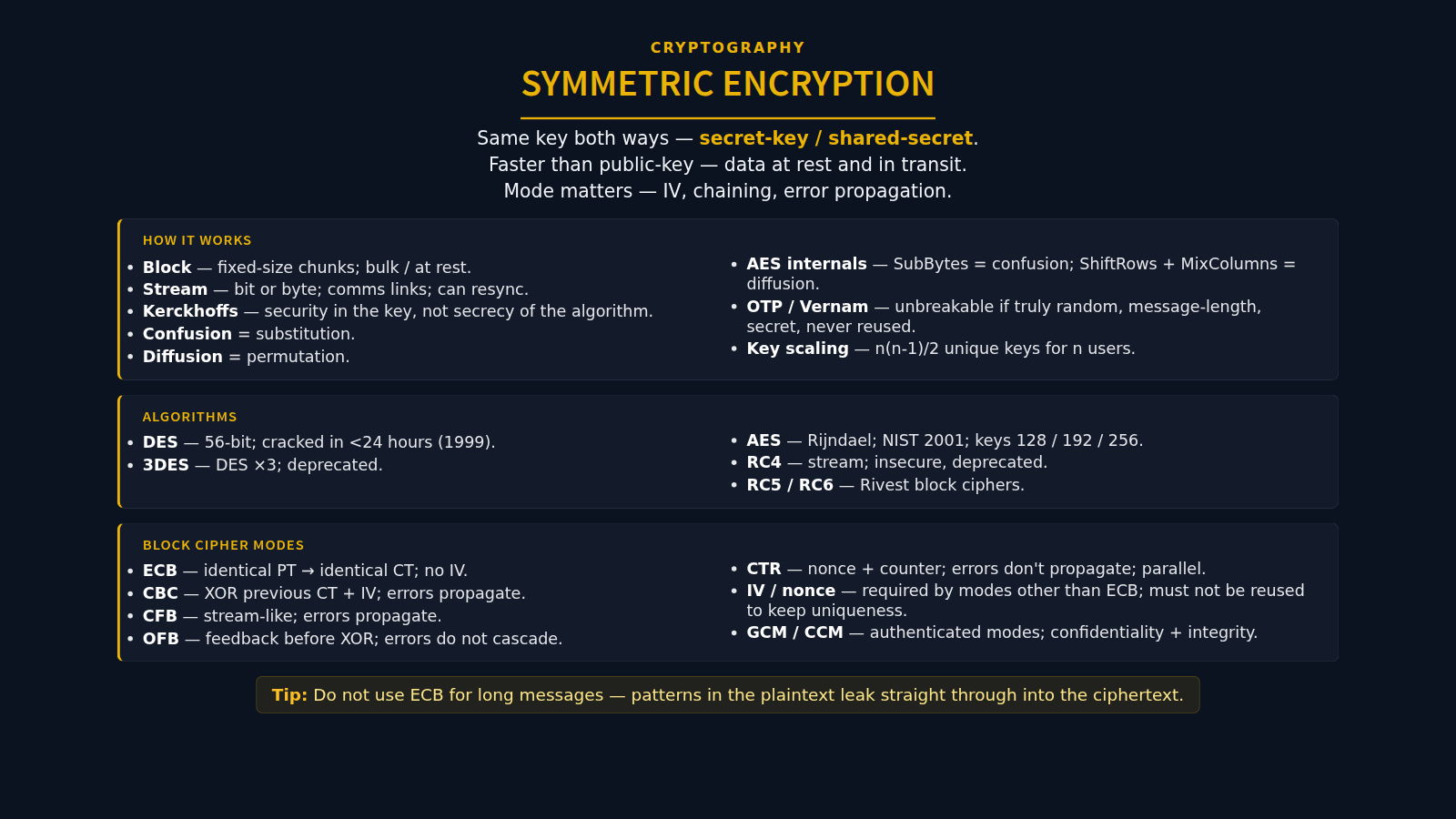
Symmetric encryption uses one shared secret both ways — fast enough for data at rest and bulk data in transit, but only as strong as the key, the algorithm, and the mode. In Part 2 of our Cryptography series, we cover block vs stream, Kerckhoffs's principle, confusion and diffusion, the one-time pad, DES / 3DES / AES, the five named modes, and authenticated modes GCM and CCM.
What you will learn
- Why symmetric encryption is called secret-key or shared-secret — same key both ways
- Block ciphers vs stream ciphers — bulk / at rest vs communications links
- Kerckhoffs's principle — security in the key, not secrecy of the algorithm
- Confusion = substitution; diffusion = permutation (transposition)
- The one-time pad (Vernam) — random key, same length, used once, kept secret — or it is not a one-time pad
- The n(n-1)/2 key-sharing problem
- DES (56-bit, broken in 1999), 3DES (deprecated), AES (Rijndael, NIST 2001, 128/192/256)
- Five modes: ECB, CBC, CFB, OFB, CTR — IV, error propagation, and why ECB leaks
- Authenticated modes GCM and CCM — confidentiality plus integrity
- Why identical plaintext producing identical ciphertext means ECB