Home › Security Architecture & Engineering
PKI Explained — Cryptography (Part 5)
Security Architecture & EngineeringCISSPSecurity+
PKI uses a certificate authority to bind a name to a public key — and a digital signature applies a private key to a message digest; it is not encryption of the message. In Part 5 of our Cryptography series, we cover CSRs, X.509, SAN versus CN, DV and EV, CRL and OCSP, the signature process, and what a signature actually proves.
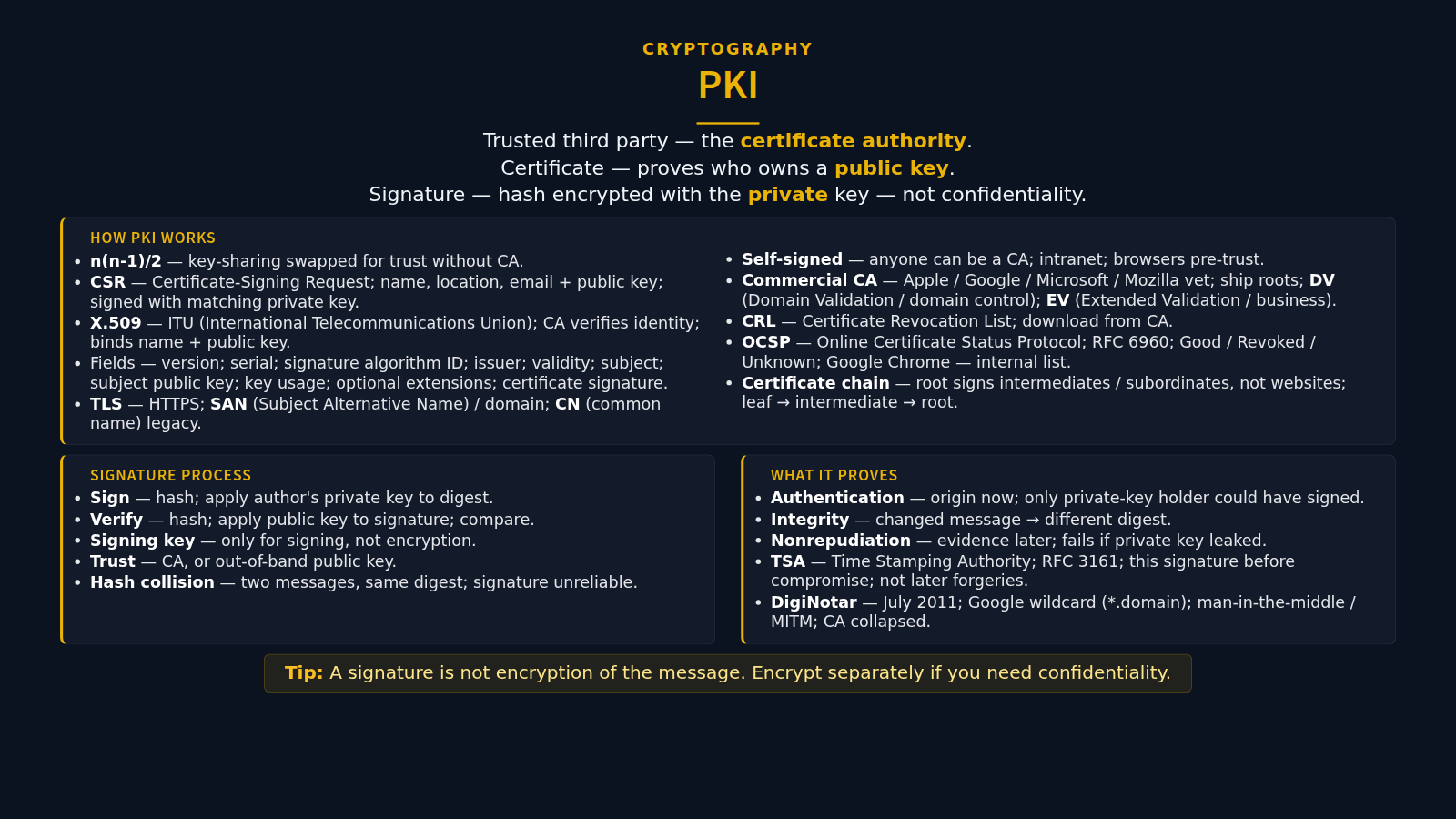
What you will learn
- Why a trusted third party — the CA — is needed once public keys scale
- How n(n-1)/2 key-sharing becomes an n(n-1)/2 trust problem without a CA
- The CSR: name, location, email plus public key, signed with the matching private key
- X.509 (ITU): binds name + public key; fields; TLS / HTTPS
- SAN — Subject Alternative Name — versus legacy subject CN
- Self-signed vs commercial CAs; DV vs EV
- Revocation: CRL vs OCSP (RFC 6960: Good / Revoked / Unknown)
- The certificate chain: root signs intermediates, not websites
- How a digital signature is produced and verified, and why the signing key is signing-only
- Out-of-band public-key trust, and why a hash collision breaks a signature
- What it proves: authentication, integrity, nonrepudiation — not confidentiality
- Time Stamping Authority (RFC 3161) if the private key is later compromised
- What happens when a CA is compromised — DigiNotar, July 2011