Home › Security Architecture & Engineering
Harrison-Ruzzo-Ullman (HRU) Model Explained — Security Models (Part 7)
Security Architecture & EngineeringCISSP
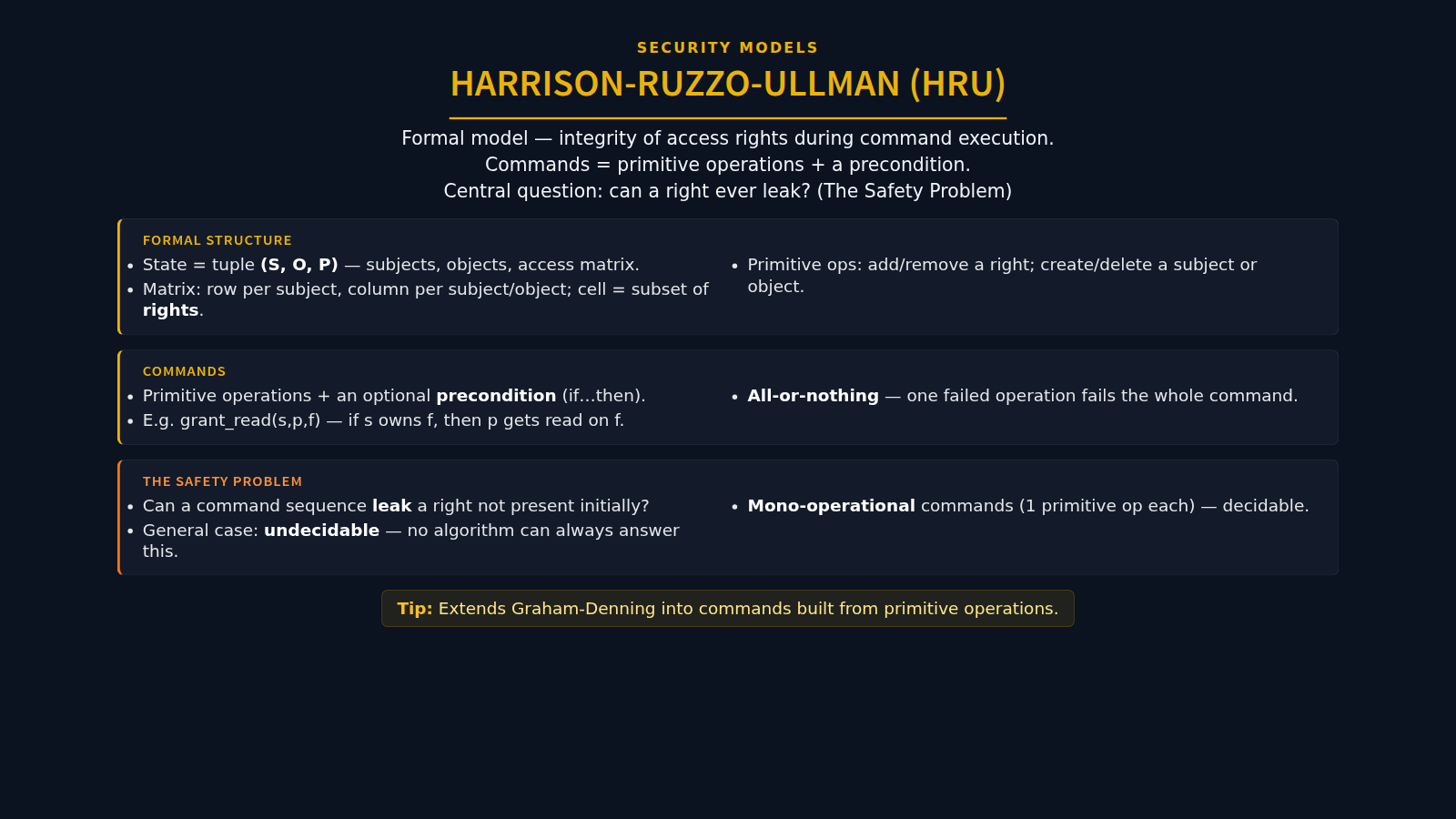
Harrison-Ruzzo-Ullman formalizes how access rights stay consistent as commands run — and answers one of the most famous theoretical questions in access control: can a right ever leak? In Part 7, we cover the model's formal structure, how commands are built from primitive operations, and the safety-problem result that made this model famous.
What you will learn
- What the Harrison-Ruzzo-Ullman (HRU) model is, and how it extends Graham-Denning
- The formal structure: subjects, objects, and the access matrix
- Primitive operations, and how commands combine them with a precondition
- A worked command example: grant_read
- Why commands are all-or-nothing
- The Safety Problem — can a right ever leak into the system?
- The headline result: undecidable in general, decidable for mono-operational commands