Home › Communication & Network Security
SAVNET (Source Address Validation) Explained in 5 Minutes
Communication & Network SecurityCISSP
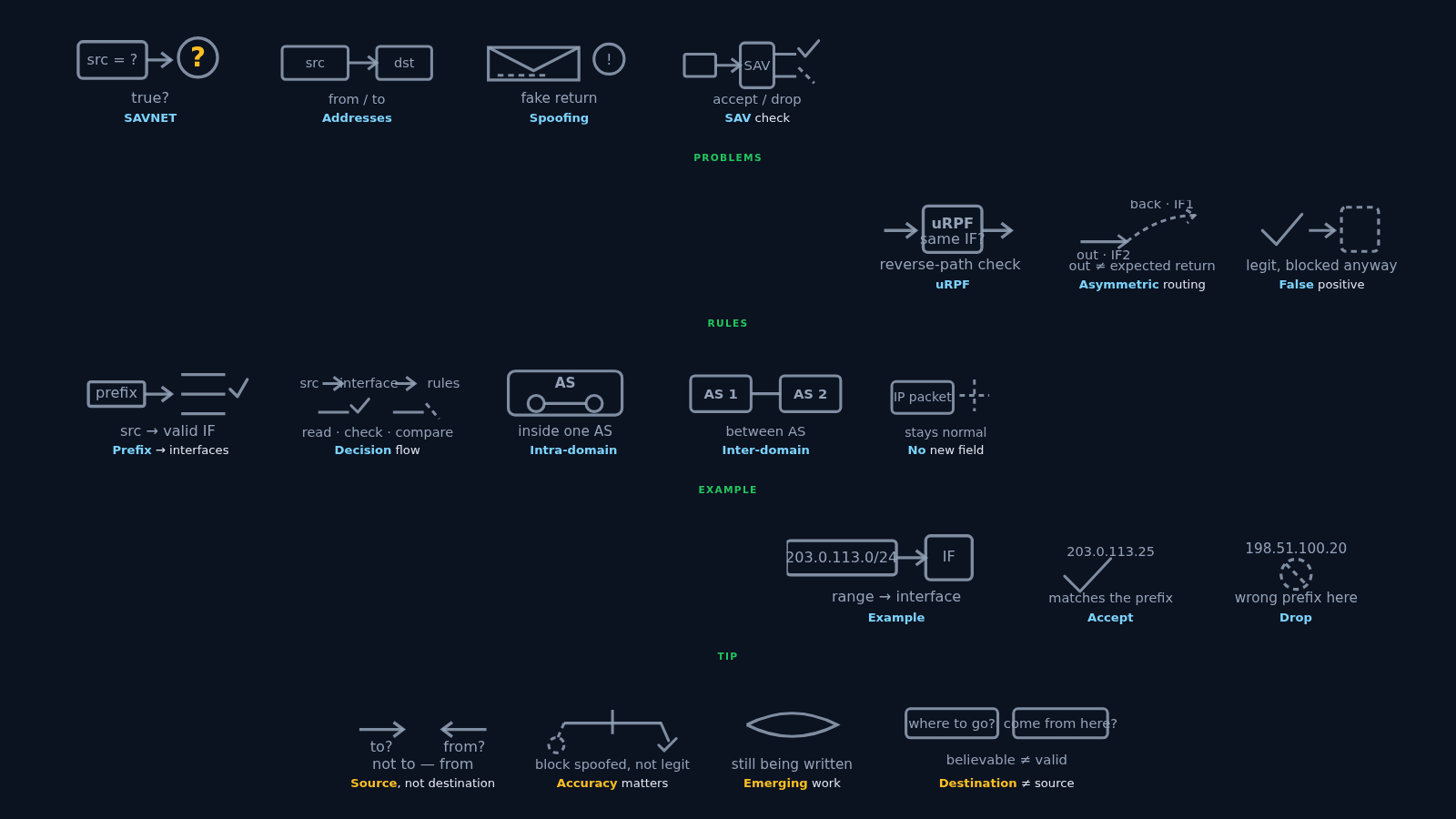
SAVNET asks a simple question: how does a router know the source IP inside a packet is telling the truth? In this Communication & Network Security video, we connect Source Address Validation (SAV) and IP spoofing to strict uRPF and the asymmetric-routing false positive problem it can create, then walk through what the IETF SAVNET working group is building — intra-domain and inter-domain source validation, prefix-to-interface rules, and why it avoids adding any new field to the IP packet.
What you will learn
- Why a source IP can't just be trusted
- IP spoofing and what Source Address Validation (SAV) tries to stop
- Strict uRPF and the asymmetric-routing false positive problem
- What the IETF SAVNET working group is actually building
- Intra-domain (inside one AS) vs inter-domain (between AS) validation
- Why SAVNET works with IPv4 and IPv6, with no new packet field
- A worked example — accept 203.0.113.25, drop 198.51.100.20
- Three tip ideas: source not destination, accuracy, emerging work