Home › Communication & Network Security
802.1X Explained: How Network Access Control Keeps Devices Out
Communication & Network SecurityCISSPSecurity+
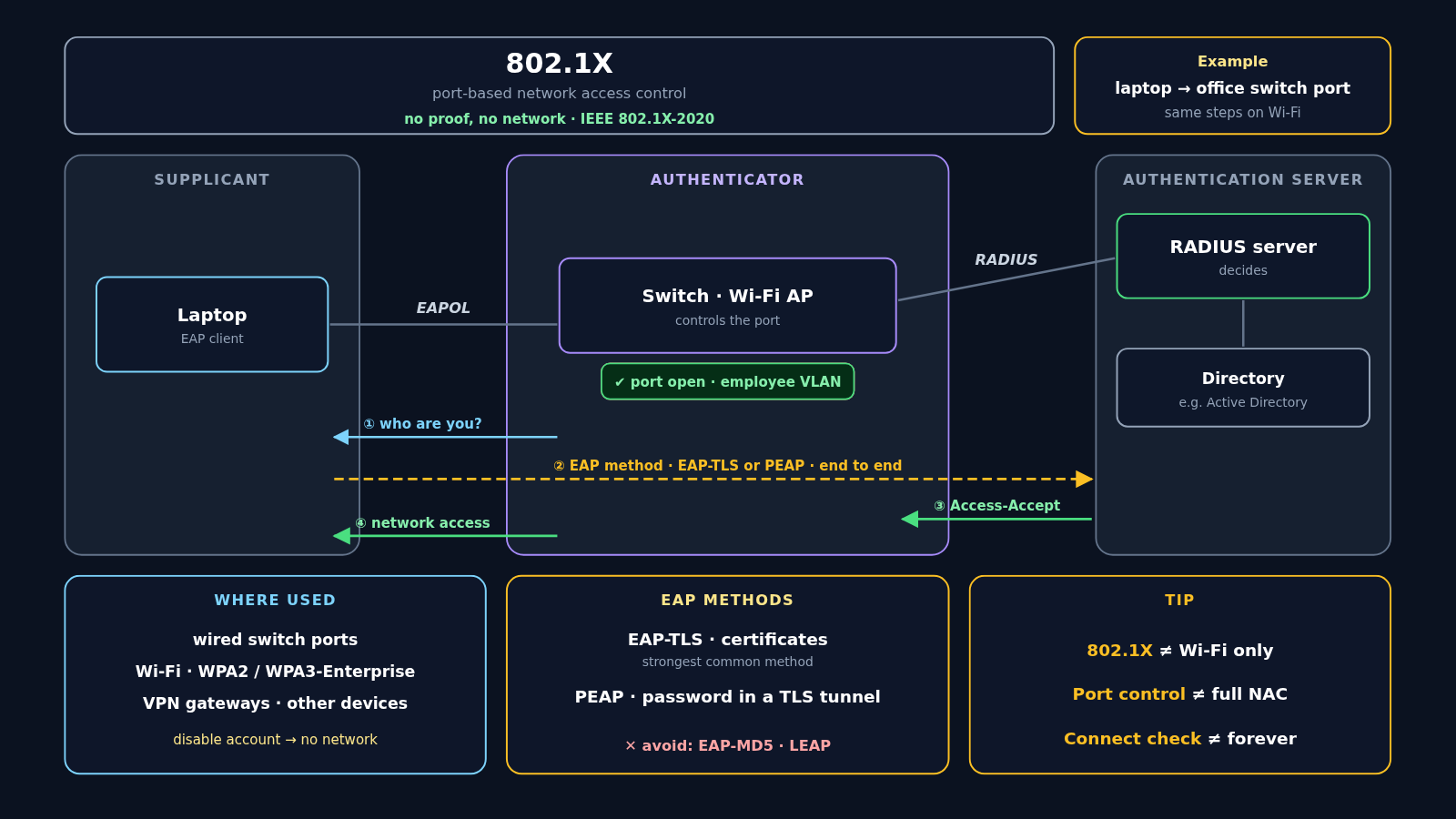
Plugging a laptop into an office wall socket should not be enough to get on your network. In this video, I'll walk through 802.1X, the IEEE standard for port-based network access control: the supplicant, the authenticator and the authentication server, how EAP and RADIUS carry the check, how the port opens and a VLAN is assigned, and where 802.1X fits with full network access control.
What you will learn
- What 802.1X is, and the example: a laptop plugged into an office switch port
- The three roles: supplicant, authenticator (switch or Wi-Fi AP) and authentication server (RADIUS)
- EAPOL and RADIUS, and why the switch is only a middleman
- The flow: identity request, EAP method, Access-Accept, port open with a VLAN
- EAP-TLS vs PEAP, and the weak methods to avoid
- Where 802.1X is used: wired ports, WPA2/WPA3-Enterprise, VPN gateways
- Three tip ideas: 802.1X ≠ Wi-Fi only; port control ≠ full NAC; connect check ≠ forever