Home › Software Development Security
Agentic Application Security Explained: Securing AI That Can Take Action
Software Development SecurityCISSPSecurity+
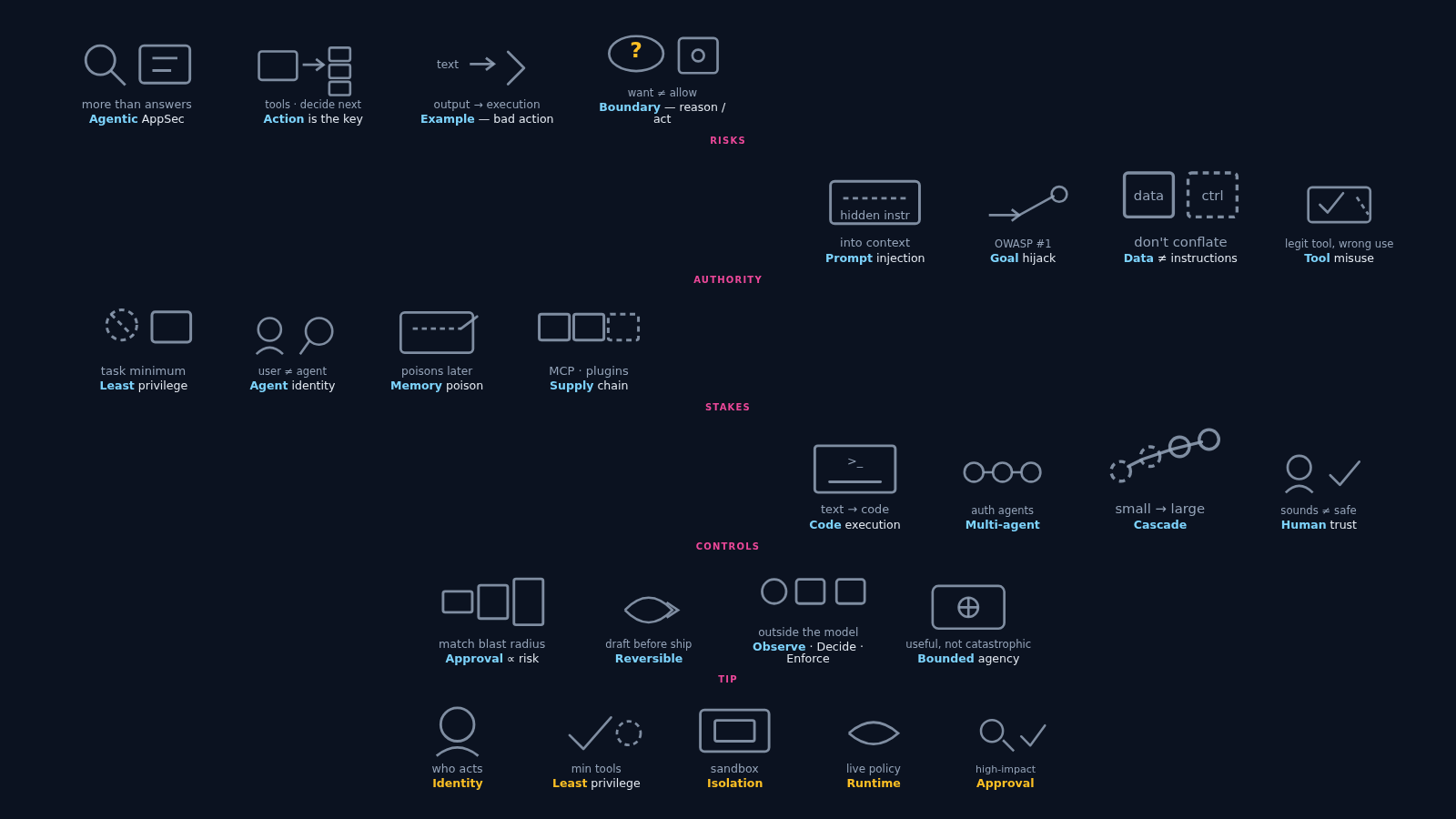
When AI can take action — call tools, change systems, spend money — application security has to protect more than code and APIs. In this video I'll walk you through agentic AppSec: why action changes the threat model, OWASP agentic risks like goal hijack and memory poisoning, agent identity and least privilege, MCP and supply-chain trust, multi-agent failure modes, and the controls that keep capable agents inside boundaries you can observe and revoke.
What you will learn
- Why agents move risk from bad output to bad execution
- The trust boundary between reasoning and permitted action
- Prompt injection, Agent Goal Hijack, and instructions vs data
- Tool misuse, least privilege, and agent vs user identity
- Memory/context poisoning and agentic supply chain (including MCP)
- Unexpected code execution and coding-agent attack surface
- Multi-agent trust, cascading failure, and human-agent trust exploitation
- Approval matched to risk, reversibility, and Observe · Decide · Enforce
- Five tip controls: identity, least privilege, isolation, runtime, approval