Home › Security Assessment & Testing
Adversarial Exposure Validation (AEV) Explained
Security Assessment & TestingCISSPCySA+
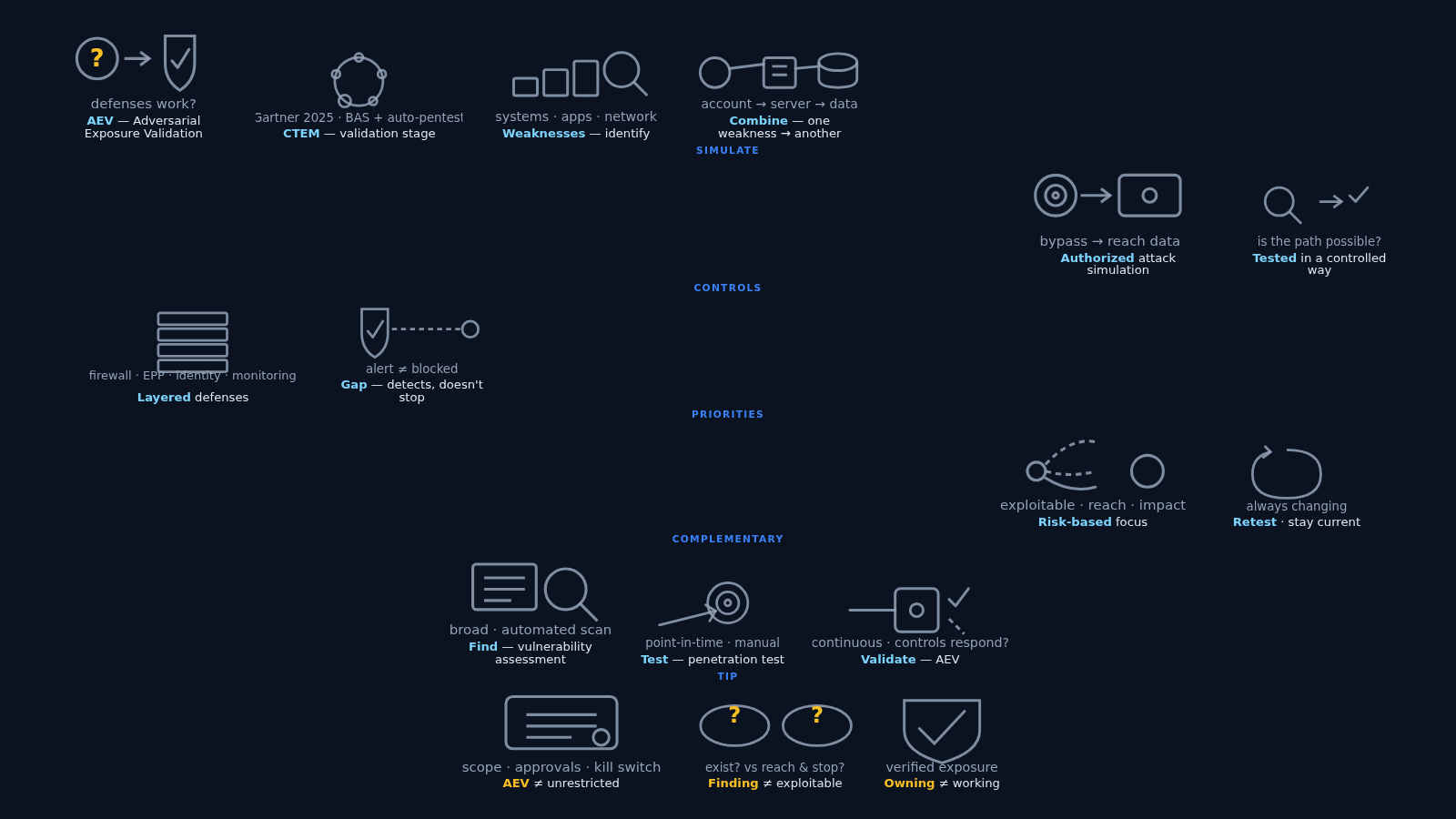
Finding a vulnerability isn't the same as proving an attacker can actually use it. In this video, I'll walk through Adversarial Exposure Validation (AEV) — how authorized attack simulations test whether real attack techniques can chain weaknesses together, bypass your security controls, and reach sensitive data, plus how AEV fits alongside vulnerability assessments and penetration testing instead of replacing them.
What you will learn
- What Adversarial Exposure Validation (AEV) is, and why finding a weakness isn't the same as it being exploitable
- Where the term comes from — Gartner's category merging BAS with automated pentesting, and the validation stage of CTEM
- How small weaknesses combine into a real attack path — the excessive-permissions-plus-misconfigured-server example
- Authorized attack simulation — testing that exact attack path in a controlled way
- Testing security controls (firewalls, endpoint protection, identity tools, monitoring) for real response, not just presence
- Prioritizing remediation by exploitability, reach, control failure, and business impact
- Why continuous validation matters as environments keep changing
- How AEV compares to vulnerability assessment and penetration testing
- Three tip ideas: AEV ≠ unrestricted; finding ≠ exploitable; owning ≠ working